

Learn
Saltwater Hot Tubs: The Honest Truth

A Balanced Look at Salt Systems, What They Actually Do (and Don’t Do), and How Modern Water Care Has Moved On
If you’ve been researching hot tubs recently, you’ve almost certainly come across saltwater systems. They’re marketed as a simpler, more natural way to keep your spa water clean — and for a lot of people, the pitch sounds appealing. Less chemicals, softer water, hands-off maintenance. What’s not to like?
Well, quite a bit, actually — once you look past the marketing and into what owning a saltwater hot tub really involves. This isn’t a hit piece. Salt systems have their place and there are things they do well. But there’s a gap between what’s promised and what’s delivered, and we think you deserve to know the full picture before you commit.
Full disclosure: we sell Sundance® spas, which don’t use a salt system. But here’s the interesting thing — Sundance® actually brought a salt system to market back in 1999, called the ISO-Pure. They walked away from it. So did nearly every other manufacturer who tried. There are good reasons for that, and we’ll get into them.
How Does a Saltwater System Actually Work?
A saltwater hot tub doesn’t eliminate chlorine — it generates it. You dissolve salt into the water, and an electrolytic cell (sometimes called a salt cell or cartridge) runs a low electrical current through it. This splits the salt (sodium chloride) into its component parts through electrolysis, producing chlorine to sanitise the water.
So the water is still chlorinated. The difference is that instead of you adding chlorine granules by hand, the system produces it automatically. That’s a genuine convenience — but it’s important to understand what you’re actually getting. It’s not chemical-free. It’s not chlorine-free. It’s a different method of delivering the same sanitiser.
The “Maintenance-Free” Myth
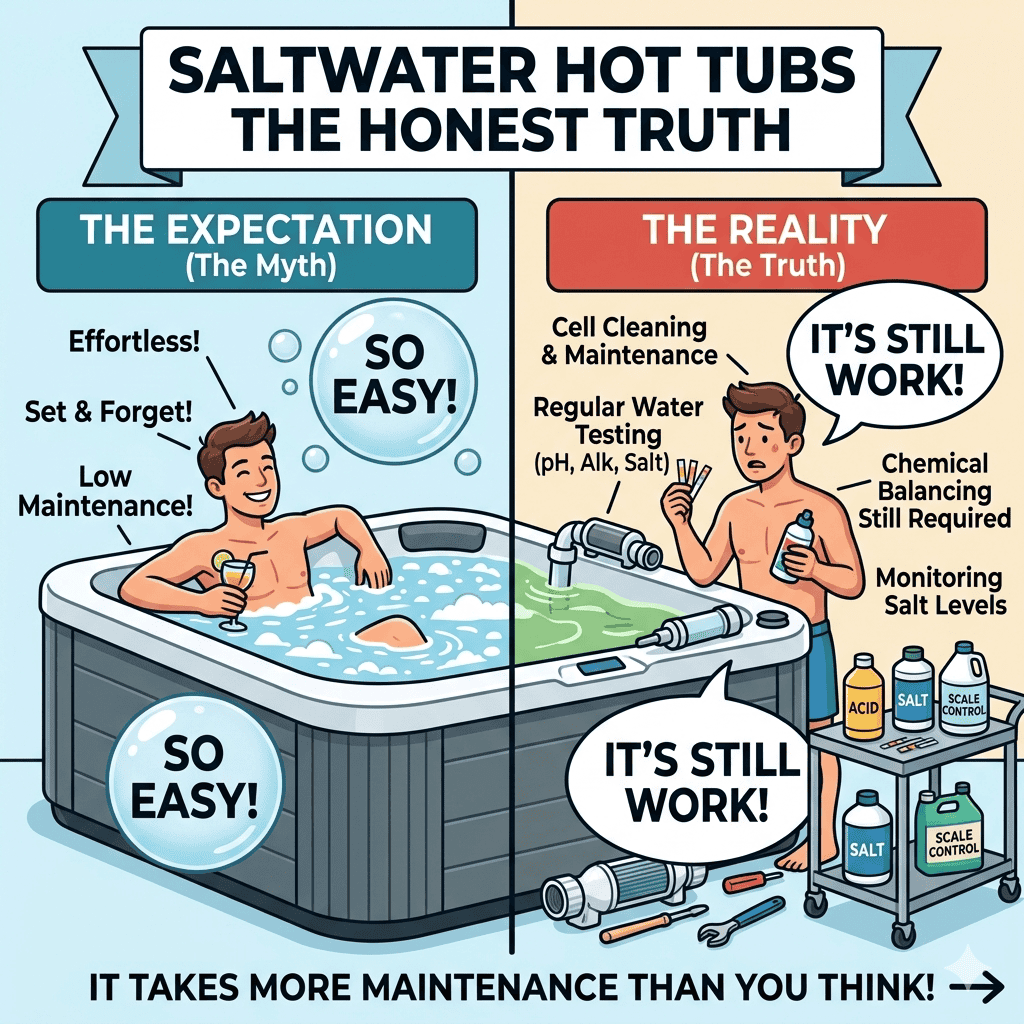
This is the big one. Salt systems are heavily marketed as low-maintenance or even maintenance-free. But the reality, even according to the manufacturers’ own documentation, tells a different story.
A salt system does one job for you: it generates chlorine. That’s it. Everything else? Still your responsibility.
Here’s what you still need to do, even with a salt system fitted:
- Test and balance your pH regularly — this is particularly important because the electrolysis process naturally raises pH. The hydrogen gas produced during electrolysis causes CO₂ to off-gas from the water, which pushes pH upward. You’ll likely find yourself adding pH reducer more often than you would with a traditional system.
- Manage total alkalinity — closely linked to pH, and the constant upward pressure on pH makes alkalinity management trickier.
- Shock the spa weekly — even the manufacturers recommend a non-chlorine shock once a week to keep the water in good condition.
- Manually dose chlorine when needed — if you use the spa heavily or have a few guests over, the salt cell may not keep up. You’ll need to add chlorine granules by hand. Some retailers openly acknowledge that the system handles sanitation on its own most of the time, but not all of the time — meaning there will be occasions when you’re back to dosing chlorine by hand.
- Clean the filters — salt doesn’t replace filtration. Filters still need regular cleaning, just as with any hot tub.
- Change the water — salt system sellers recommend a full water change once a year (some more frequently). The water doesn’t last forever.
- Monitor calcium hardness — salt systems require very specific calcium levels (typically 25–75 ppm), much lower than traditional systems. Getting this wrong causes scaling, equipment damage, or both.
When you add it all up, the maintenance isn’t dramatically less than a well-managed traditional hot tub. The salt cell handles one task — chlorine generation — but the rest of the water chemistry is still on you.
What Does It Actually Cost?
Salt systems aren’t cheap. The initial system itself can add anywhere from £500 to several thousand pounds to the price of your hot tub, depending on the brand and model. But the upfront cost is only part of the picture.
The salt cell — the cartridge that does the actual work — has a limited lifespan. Most last around four months before they need replacing. That’s three cartridges a year, typically sold in packs of three for somewhere around £200–£250. So you’re looking at roughly £200+ per year just on cells, before you factor in the salt itself, pH adjusters, shock treatments, test strips, and any other chemicals you still need.
Compare that with a traditional system where a year’s supply of chlorine, pH adjusters, and shock might come in at £100–£150. The salt system’s ongoing costs are often higher, not lower.
The Hard Water Problem
This is something we feel strongly about, particularly given where we’re based. Much of the south of England has hard water, and salt systems are not well suited to hard water areas.
The electrolysis process constantly pushes pH upward. In hard water, where calcium levels are already elevated, high pH accelerates calcium scaling — that chalky white buildup you see on taps and kettles. In a hot tub, this scaling can coat the heater element, jets, and internal plumbing. Over time, it reduces efficiency, increases running costs, and can cause equipment failures.
Salt systems require calcium hardness to sit between just 25–75 ppm. For context, many areas of Dorset, Hampshire, and the wider south have tap water with calcium levels of 200 ppm or more. That’s three to eight times higher than what the system needs.
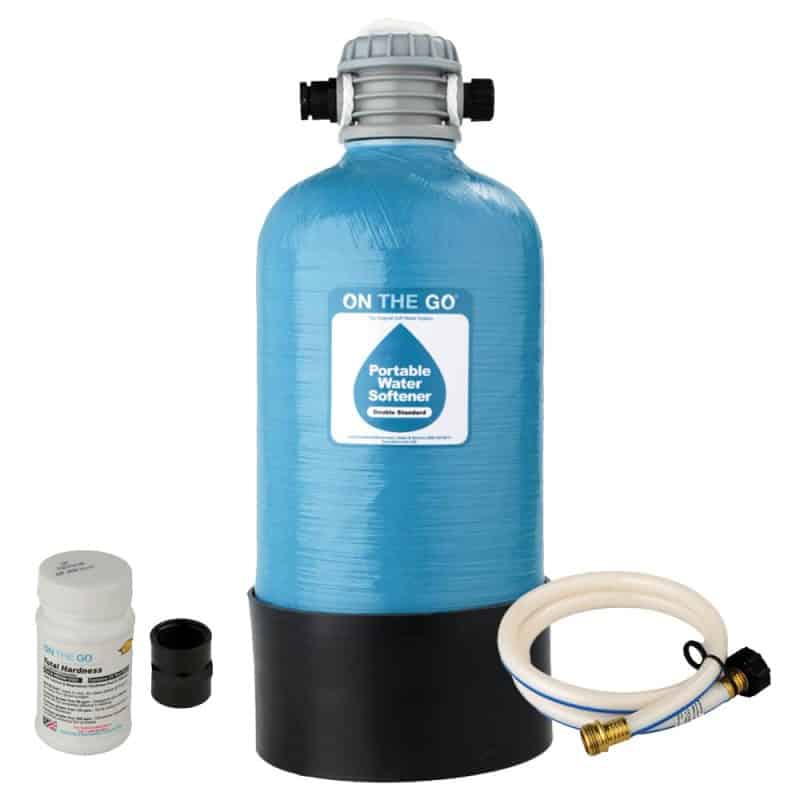
Some manufacturers actually recommend purchasing a portable water softener to pre-treat the water before filling your tub. That’s an additional cost of around £359 and an extra step — and if you don’t do it, you risk voiding your warranty or damaging equipment. It’s worth asking: if a system needs you to buy additional hardware just to make it viable, how simple is it really?
Equipment and Warranty Concerns
Salt is corrosive. Even at the low concentrations used in hot tubs, salt water can accelerate wear on metal components — heater elements, jet fixtures, and internal fittings. Heat makes this worse, and a hot tub is, by definition, a heated environment.
Some manufacturers have addressed this with titanium components and salt-resistant materials, but not all have. And if you retrofit an aftermarket salt system to a tub that wasn’t designed for one, you could void your warranty entirely. Damage from salt corrosion is often classified as “chemical abuse” and excluded from coverage.
It’s also worth noting that the warranty on the salt system itself is often shorter than the warranty on the hot tub — typically just one year, compared to two to five years for other sanitation systems.
Why Sundance® Walked Away from Salt
Back in 1999, Sundance® Spas introduced the ISO-Pure salt water system. They were among the first to market with the technology. But within a couple of years, they discontinued it. The replacement circuit boards weren’t even compatible with the salt system — a clear signal that the company had moved on permanently.
Instead, Sundance® chose to invest in a different approach to water care: tackling filtration and purification rather than just chlorine delivery.
The result is a two-part system that we think is genuinely better. MicroClean® filtration uses tighter pleats and higher-grade filter media to capture particles far smaller than a standard hot tub filter can manage. This means the water passing through a Sundance® spa is being filtered to an exceptionally high standard before it even reaches the sanitiser.
Then there’s ClearRay® Active Oxygen, which uses UV-C light to neutralise up to 99.9% of waterborne pathogens. It’s a proven technology — UV-C is used in hospitals and water treatment plants worldwide — and it works continuously without adding any chemicals or byproducts to the water. The combination of advanced filtration and UV purification means you need far less sanitiser in the first place. The water is cleaner because the system prevents contamination rather than just treating it after the fact.
You still use a small amount of chlorine or bromine as a residual sanitiser — no system eliminates that entirely — but the amount is significantly reduced. And crucially, there’s no impact on pH, no salt cells to replace, no corrosion risk, and no special water hardness requirements.
The Honest Summary
Salt systems aren’t bad. For some owners in soft water areas who want the feel of softer water and don’t mind the ongoing costs and maintenance, they can work well. The water does feel pleasant, and there is a genuine convenience in having chlorine generated automatically.
But they’re not the low-maintenance miracle they’re sometimes made out to be. You still need to test, balance, shock, and manage your water. The costs are real and ongoing. And if you’re in a hard water area — as many of us in the south of England are — a salt system introduces problems that simply don’t exist with a well-designed traditional water care approach.
We chose to partner with Sundance® because we believe their approach — filtering the water more effectively and purifying it with UV light — is a smarter, more reliable solution. It’s the kind of engineering that quietly does its job without creating new problems to solve.
Visit us to feel the Sundance difference
If you’d like to learn more about how Sundance® water care works in practice, you’re welcome to pop into our showroom in Wimborne for a chat. No pressure, no hard sell — just honest advice. You can even book a wet test and see the difference for yourself. Give us a call on 01202 985125 or visit hyperionhottubs.co.uk.